Techniques & Technologies for Temperature Sensing
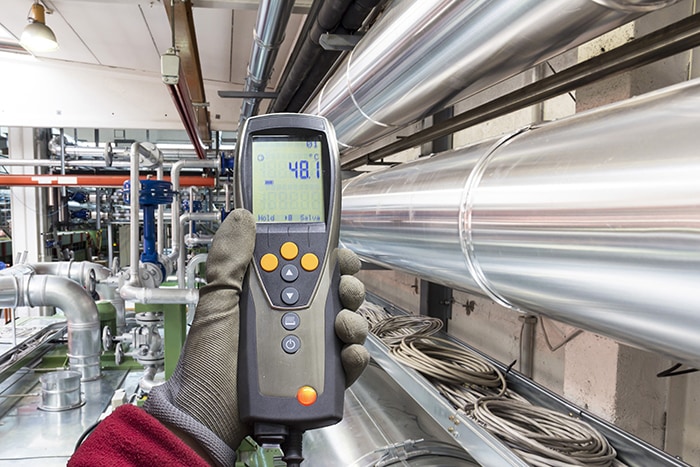
Image Source:
caifas/shutterstock.com
By Mark Patrick, Mouser Electronics
Published February 14, 2020
Sensing is taking on a greater importance as our world becomes more automated, and while we can detect
more parameters than ever before, the ability to accurately determine temperature levels is still one of the
most important functions of electronic design. Temperature information is valuable in almost all aspects of our
lives—whether it is the surroundings we are living in, the oven where we cook, or even our own body
temperature. In industry, monitoring the temperature of machinery and computing technology can provide early
fault detection or prolong working lifespans by maintaining optimum temperatures. Temperature can be measured in
several ways, each of which has different benefits and is suited to different application scenarios. This
article will look at three of the most common ways of measuring temperature—namely through thermistor,
thermocouple, and infrared (IR) technology.
Thermistors
A thermistor is a resistor with
resistance that varies depending on the temperature it is exposed to (Figure 1) either via
ambient air or a surface it is in contact with (or possibly even embedded into). These simple devices are made
from metallic oxides that are pressed into a convenient bead, disk, or cylinder that is then encapsulated
in epoxy or glass. Depending on the materials chosen the resistance can either increase with temperature,
in the case of a positive thermal coefficient (PTC), or reduce if a negative temperature coefficient (NTC)
is present. NTC types are generally the more popular components for thermal measurement, while PTC types
are most often used as thermal fuses.
On the positive side, thermistors are very simple to use, inexpensive to buy, inherently rugged and respond
predictably to temperature changes. Although the resistance change is nonlinear, it does follow
a curve that is defined for a particular model of thermistor. Thermistors are also very sensitive and precise,
plus they have strong stability. However, they are not suitable for measuring a wide temperature variation and
typically only operate in a fairly narrow range around a set "base" temperature. This, as well as their slow
response time, can limit the applications for which they are suited.
Figure 1: Example of a NTC thermistor curve showing the relationship
between resistance and temperature. (Source: Mouser Electronics)
Thermistors are versatile and can measure ambient temperature, as well as having the capacity to be bonded to a
surface or even placed inside an object (such as a heatsink) to measure the temperature there. When bonded to a
surface, or embedded, thermistors are an intrusive form of measurement, meaning that their presence can
influence
the temperature being measured. In practice, thermistors are very small with minimal thermal mass,
and this is rarely an issue in most use cases. With the growth in battery-powered technology, thermistors of
this type are being utilized to monitor the temperature of rechargeable battery packs during use and also when
charging.
Thermocouples
Thermocouples
are basically two wires made from dissimilar metals that are joined together at one end and open at the other.
Temperature changes at the joined end (referred to as the "hot" junction) induce a small voltage at the open end
(the "cold" junction) in proportion to the temperature difference between the two junctions. Thermocouples
measure
differentially, so the temperature of the cold junction must be known to calculate the temperature of the
hot junction. Incidentally, using the terms hot and cold is industry-accepted nomenclature, but, in reality, the
temperature of the hot junction could easily be lower than that of the cold junction. Some have started denoting
the
junctions as "measurement" and "reference" to avoid this potential confusion.
Thermocouples are characterized by the wires employed, or specifically, the materials from which the wires are
made.
Each thermocouple is assigned a letter name, with J, K, and T being the most popular. Type K is made from two
nickel
alloys—Chromel® and Alumel®—that comprise chromium, aluminum, manganese, and silicon. The
relationship
between temperature (differential) and the voltage at the cold junction is defined by the Seebeck coefficient
measured in
μV/°C. R and S types have low Seebeck coefficients (<10) while the more popular types (J, K, T, and E)
have higher
ones (>40).
The biggest advantage of thermocouples is that they can cover an incredibly broad range of temperatures (often
from
-200°C to +2500°C), so they can be used in everything from avionics to cryogenics. They are very robust,
too,
not affected by either shock or vibration. As passive devices, they are also intrinsically safe and can,
therefore, be
deployed in hazardous environments where potentially explosive gases are present. Thermocouples have a low
thermal
mass—which means that they are fast to respond to rapidly changing temperatures, often in less than a
second.
They are not perfect for all applications, though, with one of the biggest challenges being the very low signal
level
produced. This can require advanced signal conditioning to enhance the signal-to-noise ratio. As thermocouples
are long
wires, they are very susceptible to noise pickup from stray electrical and magnetic fields, although this can be
reduced
by twisting the wires together or running them in a shielded conduit. They are also potentially prone to
corrosion. The
other main drawback is that they are not particularly accurate (typically within ±1°C or so). This is an
issue when
measuring relatively low temperatures, but entirely adequate when measuring something like a jet engine or a
flame.
Furthermore, the output from a thermocouple is not linear, although J and K types do have significant (almost)
linear
regions, which is one reason for their popularity.
Design engineers who want to use the flexibility of thermocouples without having to address the challenging
signal
processing requirements can use the MCP9600/L00
from Microchip (Figure 2). This device connects directly to a thermocouple (K, J, T, N, S, E, B
or R types)
and provides all necessary signal conditioning and nonlinearity correction to the thermocouple voltage,
outputting the
temperature value via a two-wire I2C bus at 100kHz. The device is suitable for IoT-based
battery-powered applications
with an operating current of just 300μA, and drawing a mere 2μA when in shutdown mode. Four registers are
built
into each unit, allowing individual temperature alerts to be set.
Figure 2: The Microchip Technology MCP9600/L00/RL00 digital temperature
sensor comes with
user-programmable registers which provide design flexibility for various temperature sensing applications
such as Low-Power
modes for battery-powered applications. (Source: Mouser Electronics)
IR Temperature Measurement
Both thermistors and thermocouples are contact-type measurements, meaning that they have to be in contact with
whatever
they are measuring. This can, in certain circumstances, be inconvenient and in others might affect the
measurements
derived—as the measurement probe can act as a heatsink. IR temperature sensing is becoming popular in
applications
such as medical and industrial, as it is accurate, reliable and robust. This works on the basis that every
single thing
emits thermal radiation, and relies on the Stefan-Boltzmann law (which states that energy radiated per unit
surface area
of a black body is proportional to the fourth power of its temperature).
A thermopile sensor uses a thin, thermally isolated membrane that is connected to several micro-miniature
thermocouples in
series. As the membrane has a low thermal mass, it can heat rapidly®allowing measurements to be taken
subsequently.
A reference thermistor determines the temperature of the cold junction so that an absolute temperature can be
generated.
In order to miniaturize the sensors for inclusion in portable equipment (such as smartphones),
microelectromechanical
systems (MEMS) structures are often used.
One of the latest devices to rely on this technology is the noncontact
MLX90632
miniature
IR sensor from Melexis. This is factory-calibrated for ambient temperatures between -20°C ad 85°C and
object temperatures between -20°C and 200°C. The measured temperature is an average of anything that is
within the 50° field of view (FoV) of the sensor. This Melexis device includes sophisticated compensation
algorithms to ensure an accurate result is always obtained. The ultra-small sensor contains a thermopile for
measuring the energy from the object, as well as a sensor element that tracks the temperature level of the
sensor itself.
Both readings are amplified, digitized, and digitally filtered, before being stored in RAM and then made
available to
the wider system (e.g. microcontroller) via the I2C communications interface.
Summary
Temperature might be basic, but it is one of the most crucial parameters we measure. It is important in
controlling our environment
and gauging machines' performance, as well as in a healthcare context. This brief overview of the various
methods and devices
that are available for thermal monitoring (with the advantages and shortfalls of each being outlined) should
help engineers
select the best approach for their particular application.
 Part of Mouser's EMEA team in Europe,
Mark joined Mouser Electronics in July 2014 having previously held senior marketing roles at RS Components.
Prior to RS, Mark spent 8 years at Texas Instruments in Applications Support and Technical Sales roles and holds
a first class Honours Degree in Electronic Engineering from Coventry University.
Part of Mouser's EMEA team in Europe,
Mark joined Mouser Electronics in July 2014 having previously held senior marketing roles at RS Components.
Prior to RS, Mark spent 8 years at Texas Instruments in Applications Support and Technical Sales roles and holds
a first class Honours Degree in Electronic Engineering from Coventry University.